The sound
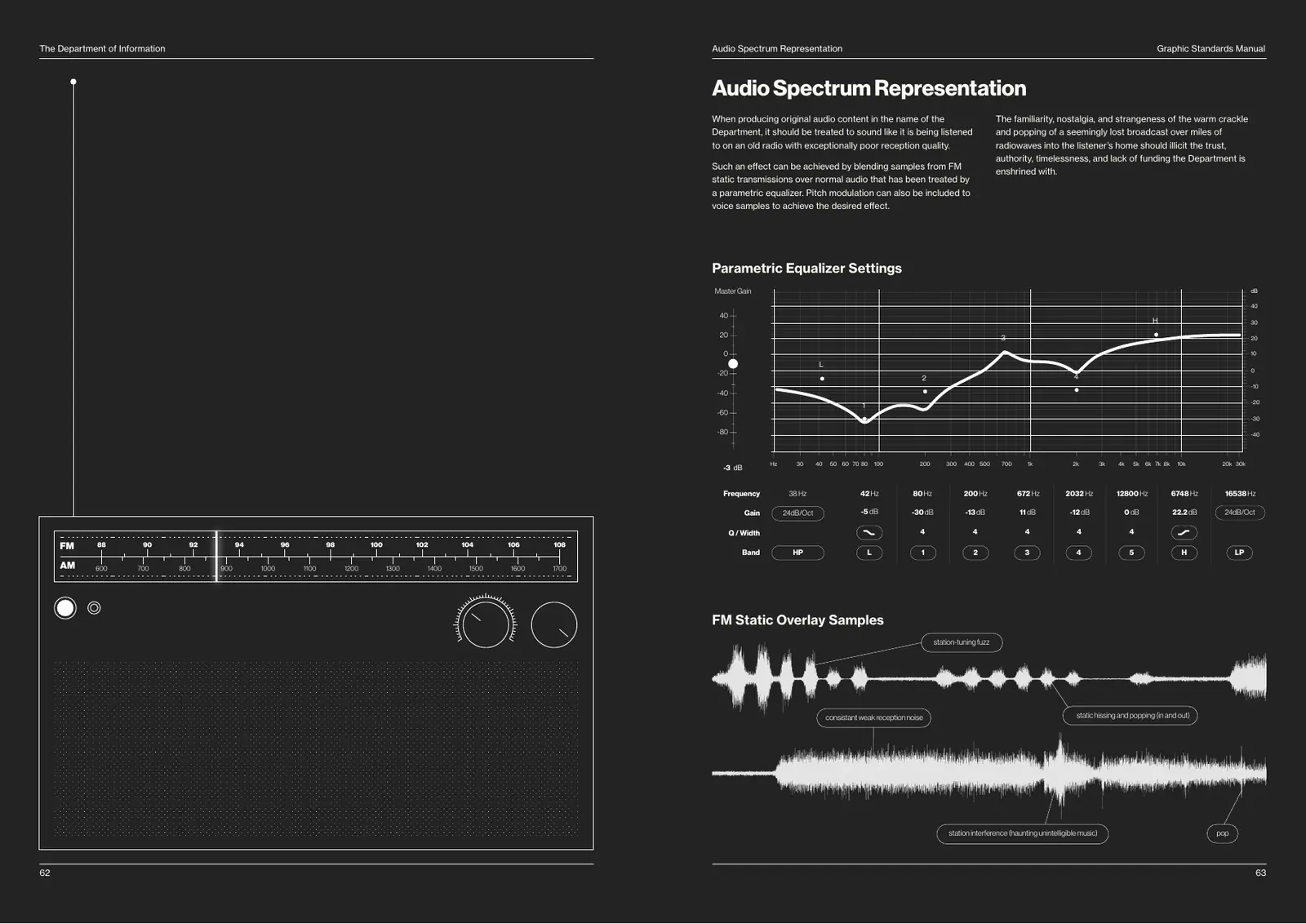
The warm crackle and pop of a seemingly lost broadcast, carried over miles of radio waves into the listener’s home, should elicit the trust, authority, timelessness and lack of funding the Department is enshrined with.
The effect comes from blending samples of FM static over normal audio that has been treated with a parametric equalizer. Pitch modulation can be added to voice samples.
Parametric equalizer settings
| Band | Frequency | Gain | Q / width |
|---|---|---|---|
| HP | 38 Hz | 24 dB/oct | |
| L | 42 Hz | −5 dB | Low shelf |
| 1 | 80 Hz | −30 dB | 4 |
| 2 | 200 Hz | −13 dB | 4 |
| 3 | 672 Hz | +11 dB | 4 |
| 4 | 2032 Hz | −12 dB | 4 |
| 5 | 12800 Hz | 0 dB | 4 |
| H | 6748 Hz | +22.2 dB | High shelf |
| LP | 16538 Hz | 24 dB/oct |
Master gain −3 dB.
FM static overlay
Layer four kinds of static under the program audio:
- Station-tuning fuzz
- Constant weak-reception noise
- Static hissing and popping, in and out
- Station interference: haunting, unintelligible music
- The occasional pop